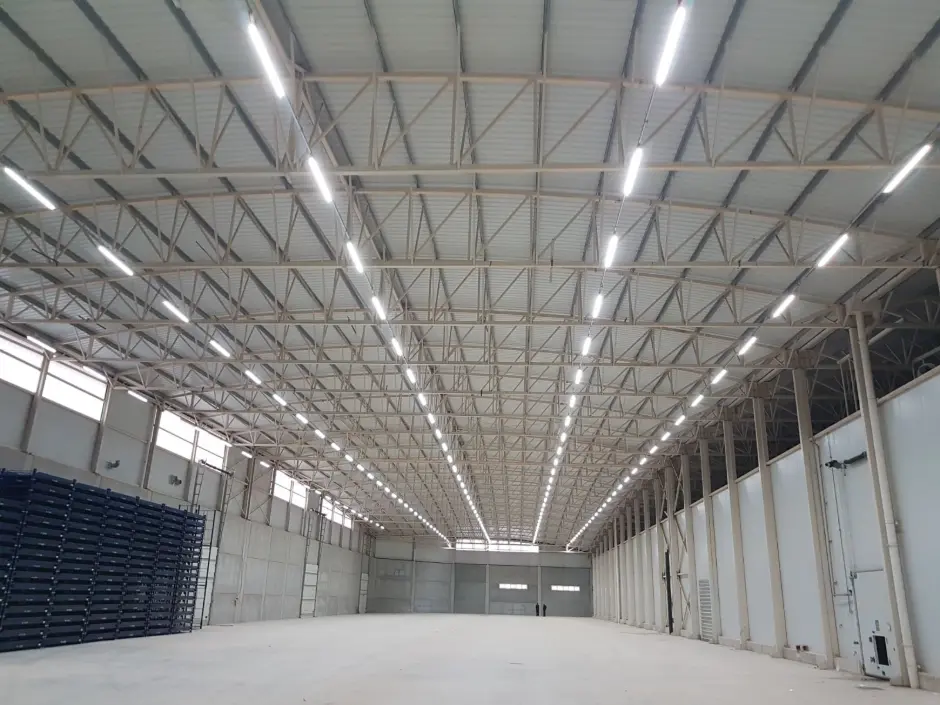
In the context of modern industry, proper lighting is not just a matter of visibility, but a strategic tool to enhance safety, energy efficiency, and productivity.
Well-balanced lighting levels are essential for establishing safe and productive working conditions. Companies must take lighting into serious consideration in the workplace where industrial activities are carried out. The optimization of industrial lighting should take into account the work activity, environmental conditions, and energy consumption. Proper lighting leads to greater productivity and accuracy, safety, protection, and a better environment for workers.
A poor choice in lighting systems can lead to accidents, low work performance, or even legal non-compliance. Therefore, understanding the lighting requirements for the industrial sector and being aware of the current lighting regulations is essential for architects, construction companies, and professionals responsible for designing efficient and safe industrial spaces.
Main lighting regulations in industries
|
Regulation |
Application |
Summary |
|
UNE-EN 12464-1:2012 |
Interiors |
Establishes minimum lighting levels in industrial work areas. |
|
UNE-EN 12464-2:2016 |
Exteriors |
Lighting requirements in docks, parking lots, roadways, etc. |
|
REBT (Low Voltage Electrotechnical Regulation) |
Electrical installations |
Regulates safety in electrical lighting installations. |
|
CTE (Technical Building Code) |
Industrial buildings |
Includes criteria for energy efficiency and lighting integration. |
|
RD 1890/2008 |
Outdoor lighting |
Regulations on energy efficiency and light pollution. |
|
NTP 1.076 (not mandatory) |
Loading docks |
Technical guide with specific lighting recommendations. |
What does the industrial lighting regulation cover?
The lighting regulations establish the minimum conditions that a lighting system must meet in work environments. This regulates aspects such as:
· The minimum illuminance (lux) according to the type of task.
· The uniformity of light (Uo) and glare control (UGR).
· Color reproduction (CRI), crucial for precision tasks.
· Technical and energy efficiency requirements for indoors and outdoors.
These regulations not only improve the well-being and safety of workers, but also ensure that the facilities are sustainable, in accordance with the current legal framework.
|
Industrial Zone |
Minimum Illuminance |
Uniformity (Uo) |
UGR |
CRI / Ra |
|
Production (general tasks) |
200 – 300 lx |
≥ 0.6 |
≤ 25 |
≥ 80 |
|
Production (fine tasks) |
Hasta 1500 lx |
≥ 0.7 |
≤ 19 |
≥ 90 |
|
Drying areas or low demand |
50 lx |
≥ 0.4 |
≤ 25 |
≥ 60 |
|
Warehouses of goods |
≥ 150 lx |
≥ 0.4 |
≤ 22 |
≥ 60 |
|
Shipping areas |
300 lx |
≥ 0.6 |
≤ 25 |
≥ 60 |
|
Loading and unloading docks |
100 lx |
≥ 0.4 |
≤ 25 |
≥ 60 |
|
Outdoor parking |
10 – 50 lx |
≥ 0.4 |
≤ 25 |
≥ 60 |
|
Outdoor industrial roads |
≥ 20 lx |
≥ 0.4 |
≤ 25 |
≥ 60 |
Key recommendations for industrial lighting
The industrial lighting standards address the importance of evaluating energy consumption and other key features aimed at improving overall performance in the workplace.
Zoning and adaptability
A proper design enhances safety, prevents errors, and optimizes consumption. Each area should have its own level of lighting according to the type of task:
- Production areas: Require between 200–1500 lux depending on the precision.
- Warehouses: Minimum illuminance of 150 lux, with linear or asymmetric optics.
- Docks and exteriors: Minimum 100 lux according to NTP recommendations.
Use of LED fixtures and smart control
Choosing industrial LED technology ensures energy efficiency, low maintenance, and a lifespan of over 50,000 hours. It is recommended to incorporate:
- DALI systems for regulation.
- Presence or natural light sensors.
- Wireless communication (ZigBee) in hard-to-reach areas.
Regulations and technical quality
The luminaires must have:
- IP65 protection (dust and water).
- Impact resistance IK08.
- Low UGR to avoid visual fatigue.
- High color rendering (CRI ≥ 80).
Resumen normativo y técnico
Este compendio normativo y técnico está presente en el desarrollo de todos los sistemas de Luxes para quirófanos y salas críticas. Desde la definición del espectro de color hasta la elección de cada lámpara quirúrgica, todo se diseña para ofrecer una experiencia visual precisa, sin sombras, y energéticamente eficiente.

NTP 1076: Loading and unloading docks: safety | INSST - PDF - INSST Portal - INSST. (n.d.). INSST Portal. https://www.insst.es/documentacion/colecciones-tecnicas/ntp-notas-tecnicas-de-prevencion/31-serie-ntp-numeros-1066-a-1101-ano-2016/ntp-1.076-muelles-de-carga-y-descarga-seguridadNTP 211: Lighting of Workplaces - PDF - INSST Portal - INSST. (n.d.). INSST Portal.https://www.insst.es/documentacion/colecciones-tecnicas/ntp-notas-tecnicas-de-prevencion/6-serie-ntp-numeros-191-a-225-ano-1989/ntp-211-iluminacion-de-los-centros-de-trabajo
UNE-EN 12464-1:2022 Light and illumination. Lighting of the places. . . (n.d.).
https://www.une.org/encuentra-tu-norma/busca-tu-norma/norma?c=N0068596